
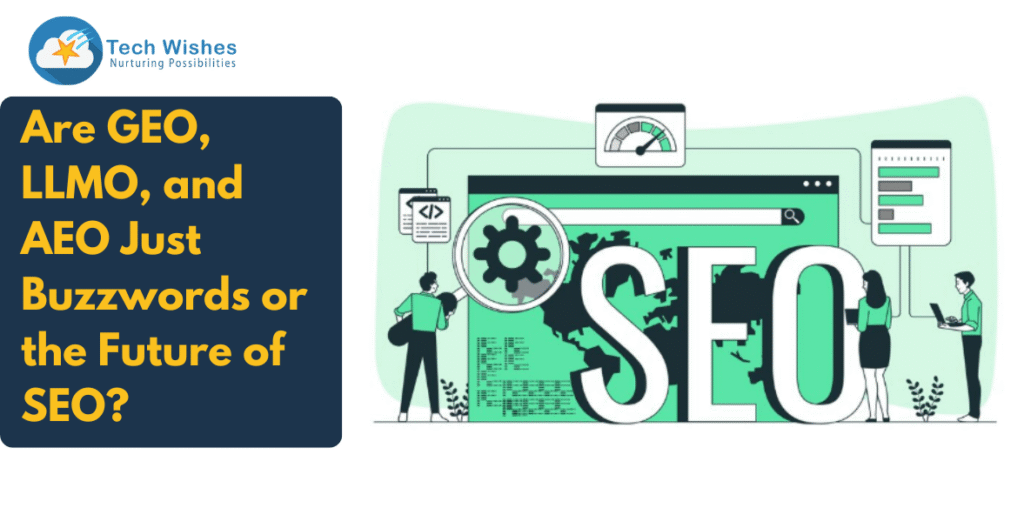
Are You Getting Lost in the Alphabet Soup of SEO Buzzwords?
In the fast-moving world of digital marketing, it’s easy to get overwhelmed. Every month, a new acronym lands in your inbox: GEO, LLMO, AEO. If you’re wondering whether you’re missing out on something game-changing, you’re not alone.
But what if we told you these aren’t entirely new strategies—just new lenses on what good SEO has always done?
In this blog, we’re breaking down what these buzzwords mean, what you should care about, and how you can stay ahead without losing your mind (or your rankings).
What Is GEO (Generative Engine Optimization)?
With AI taking over search—think ChatGPT, Google’s SGE, Bing Copilot—a new term is floating around: Generative Engine Optimization or GEO.
The idea behind GEO is this: instead of optimizing for the traditional 10 blue links on a search engine results page, you now need to optimize for AI-generated answers. These are summaries, snippets, or paragraphs generated in real-time by large language models (LLMs) when users ask questions.
So, how do you “do” GEO?
- Structure content in a way that’s easy for AI to digest
- Focus on topical depth and factual accuracy
- Include semantically related keywords and entities
- Write in a clear, human-friendly style
- Use schema markup to make your content machine-readable
But if that sounds like classic content SEO, it’s because it is. GEO doesn’t require an entirely new playbook. It just places more weight on content structure, clarity, and authority.
Truth bomb: If you’ve been creating helpful, search-friendly content all along, you’re already halfway into GEO.
What Is AEO (Answer Engine Optimization)?
Answer Engine Optimization refers to optimizing your content for AI systems and search engines that prioritize answers over links. Think about Google’s featured snippets, People Also Ask boxes, and voice search results. That’s AEO in action.
The AEO mindset asks:
- Is your content answering the user’s question directly?
- Are you formatting it in a way that makes it easy for search engines to parse?
- Are you anticipating related questions users might ask next?
To optimize for AEO:
- Use FAQ sections with structured data
- Start paragraphs with short, direct answers
- Add bullet points, tables, and numbered lists
- Use question-based headings (like this one!)
Again, this is not new, but it’s more important than ever.
Why? Because search engines are becoming answer engines. They’re trying to reduce clicks and keep users on the platform. Your job is to be the source that powers those answers.
What Is LLMO (Large Language Model Optimization)?
As tools like ChatGPT, Gemini, Claude, and Perplexity become go-to platforms for getting answers, people want to know: Can I optimize content for large language models (LLMs)?
Enter: LLMO—Large Language Model Optimization.
Unlike traditional SEO, LLMO isn’t about ranking #1. It’s about making sure your content is included in the data LLMs train on or reference during inference.
LLMO best practices include:
- Publishing original, high-authority content on your domain
- Building backlinks from authoritative and trustworthy sites
- Using descriptive titles, semantic HTML, and structured metadata
- Writing with clarity, context, and factual integrity
LLMs don’t crawl the web live like Google’s crawler. They rely on snapshots of the web and fine-tuning on high-quality content. So your brand needs to exist in the sources LLMs trust.
Bonus tip: LLMs often quote Wikipedia, government sites, academic articles, and popular news outlets. Want to get noticed? Aim for mentions and citations in those spaces.
What’s New… and What Isn’t?
Let’s cut through the hype.
All these acronyms—GEO, AEO, LLMO—are responding to the same reality: the way people search is changing. But the principles of SEO remain incredibly consistent.
Old SEO principles that still apply:
- Know your audience’s intent
- Create valuable, helpful content
- Use keywords naturally and strategically
- Make your website technically sound
- Build domain trust through quality backlinks
What’s changed is:
- The presentation of results (AI summaries vs. blue links)
- The expectation of quick, direct answers
- The importance of authority, structure, and semantic depth
How Do You Future-Proof Your SEO?
Here’s how you can stay on top, no matter what new acronym drops next:
1. Write for People First, Algorithms Second
Yes, Google’s guidelines say this. But now, so do ChatGPT, Gemini, and Perplexity. If your content genuinely helps people, it’ll be surfaced by both search engines and AI tools.
2. Use Schema and Structured Data
This helps both search engines and AI systems understand your content better. Add schema to FAQs, how-to guides, articles, and product pages.
3. Publish Content You’d Want to Be Quoted From
LLMs look for clean, informative, and context-rich writing. Think like a publisher, not just a blogger.
4. Monitor What Gets Picked Up by AI
Search for your keywords on AI tools like ChatGPT, Gemini, or Bing Copilot. See which content they pull in. Study the structure, tone, and format, and replicate what works.
5. Think Topic Clusters, Not Just Keywords
Cover a full topic thoroughly. Interlink between pages. Use subheadings that answer related questions. This increases your chances of being included in AI summaries and featured snippets.
Core Strategies That Work for All
Ready to optimize for these new search paradigms? Here’s a simple, effective approach:
|
Strategy |
Purpose |
SEO Benefit |
|
Use question-based subheadings |
Guides AI to locate answers fast |
Boosts featured snippet chances |
|
Start with a quick summary |
Helps AI summarize your content in one go |
Supports chat snippet inclusion |
|
Add FAQs with schema markup |
Provides distinct Q&A blocks for AEO |
Improves voice/AI visibility |
|
Maintain text mentions across the web |
Builds topical credibility |
Helps AI recognize your brand/topic |
|
Structure content logically & cleanly |
Human-readable and AI-friendly |
Enhances UX and AI parsing |
Stop Chasing Acronyms—Start Building Authority
Digital marketing is full of buzz. But here’s your reality check:
Whether it’s called GEO, LLMO, AEO, or whatever acronym arrives next month… It’s all just modern SEO.
The medium might evolve, but the mission is the same: Help people find what they’re looking for in the best, most trustworthy way.
So yes, keep learning. Stay curious. Experiment with new formats. But don’t get lost in the hype. Build real content, solve real problems, and you’ll win, whatever the acronym.
Looking for a future-ready SEO strategy?
Let’s talk. At Tech Wishes, we help you adapt, grow, and lead—no matter how the algorithms evolve.