
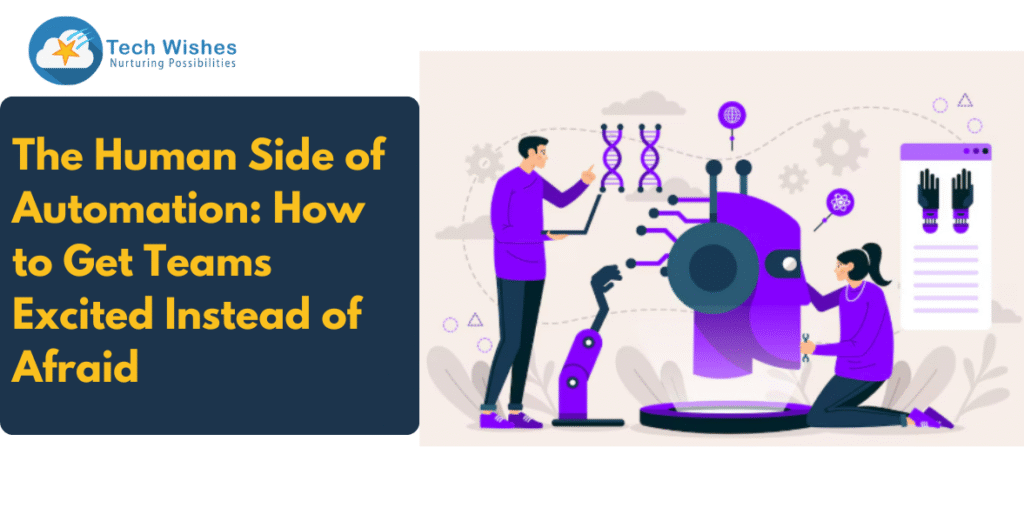
In today’s digital-first world, automation is no longer a futuristic buzzword—it’s a business necessity. From e-commerce platforms to enterprise workflows, automation helps companies scale faster, reduce repetitive tasks, and improve efficiency. But while leaders see automation as a growth lever, teams often view it with apprehension.
“Will this replace my job?”
“Am I still valuable if machines do the work?”
“Do I even have the skills to keep up?”
These are real concerns. And as a business, if you fail to address them, your automation investment can backfire. At Tech Wishes, our team of website experts has seen firsthand that the true success of automation lies not just in the tools but in how teams adopt and embrace them.
This blog explores the human side of automation—why it matters, and how you can get your teams genuinely excited instead of fearful.
Why Employees Fear Automation
Before we dive into strategies, it’s important to understand the root of workplace resistance:
Job Security Concerns
Automation often sparks fears of redundancy. Employees worry they’ll be replaced by AI-driven processes or bots.
Skill Gap Anxiety
New technologies require new skills. If training is lacking, teams can feel left behind.
Loss of Control
Many professionals equate control with competence. When processes are handed to machines, they feel disempowered.
Cultural Misalignment
Automation introduced without cultural alignment can feel like “change imposed from above,” causing resentment.
For businesses, these fears translate into disengagement, low morale, and slower adoption—all of which hurt ROI.
The Business Case for Human-Centred Automation
Automation done right doesn’t just replace tasks—it elevates teams. Instead of viewing it as a cost-cutting mechanism, companies that thrive use automation to:
- Free up time for strategic work: Imagine your marketing team focusing on campaign strategy instead of manual data pulls.
- Reduce human error: Automated reporting, invoicing, and inventory management mean fewer mistakes and rework.
- Enhance customer experiences: Automated chatbots and personalised product recommendations improve service without adding pressure on teams.
- Boost employee satisfaction: When teams are relieved from repetitive, low-value tasks, they can focus on creative and impactful projects.
This is where leadership vision meets employee empowerment—turning automation into a growth strategy instead of a fear factor.
How to Get Teams Excited About Automation
At Tech Wishes, we’ve worked with eCommerce brands and enterprises where automation adoption was smooth—and others where it failed. The difference? People-first implementation. Here are strategies you can use:
1. Start with Transparency
Be upfront about what automation means for your company. Address the elephant in the room: “We are not replacing people. We are enhancing how we work.” Clear communication reduces uncertainty and builds trust.
2. Show the “What’s In It for Me?” Factor
Employees care less about corporate efficiency and more about how automation makes their lives easier. Show them:
- Marketing automation means fewer manual reports.
- Inventory automation means no more late-night stock checks.
- Workflow automation means faster approvals and fewer bottlenecks.
When the benefits are personal, enthusiasm grows.
3. Involve Teams in the Process
Instead of imposing tools, involve teams in evaluating and testing them. A marketing manager who contributes to choosing an email automation platform is more likely to champion it.
4. Invest in Training and Upskilling
A major source of fear is the skill gap. Offer hands-on training sessions, micro-learning modules, and mentorship programs. This not only equips teams but also shows your commitment to their growth.
5. Celebrate Small Wins
Don’t wait for the full rollout to acknowledge success. Celebrate milestones like, “This new tool reduced our reporting time by 40%.” Recognition helps teams see tangible results.
6. Position Automation as a Partner, Not a Replacement
The messaging matters. Use phrases like “automation is here to support your work” instead of “automation will do your work.” Frame it as a collaboration between humans and machines.
Automation in eCommerce
Take e-commerce brands, for instance. Many teams initially resist automation in areas like cart recovery, product recommendations, or order management. They worry it takes away their creative touch.
But when implemented with a human-first approach:
- Marketing teams get deeper customer insights without manual analysis.
- Sales teams can focus on relationship-building instead of repetitive follow-ups.
- Customer support can dedicate time to complex queries while chatbots handle FAQs.
Instead of replacement, automation becomes empowerment.
Long-Term Business Benefits
When teams embrace automation, the benefits compound:
- Faster adoption of new tools → smoother digital transformation.
- Higher employee satisfaction → stronger retention.
- Improved efficiency and accuracy → better customer trust.
- Stronger competitive edge → because automation isn’t just about tech—it’s about culture.
Businesses that treat automation as a strategic partnership between humans and technology will thrive in the next decade.
Final Thoughts
Automation is inevitable. But how your company introduces it is a choice. You can either fuel fear—or inspire excitement.
At Tech Wishes, we believe the future belongs to businesses that prioritise people and processes alongside technology. When you humanise automation, you don’t just improve workflows—you unlock the full potential of your teams.
If you’re looking to implement automation in your e-commerce or business workflows and want to ensure smooth adoption, our e-commerce website experts can help you design a people-first automation strategy.