
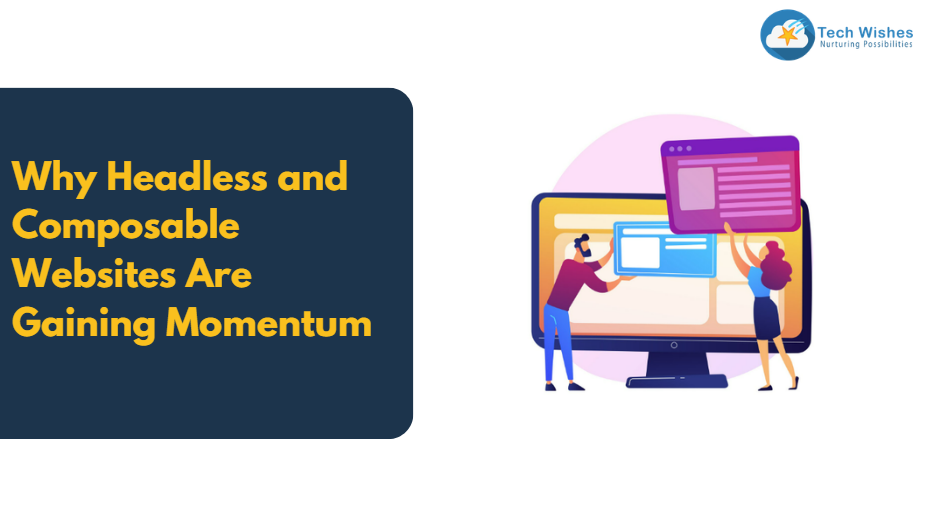
Headless and composable websites are gaining momentum because businesses want more flexibility, faster performance, and the freedom to build digital experiences without being restricted by traditional platforms. In simple terms, brands are tired of rigid systems. They want speed, scalability, personalisation, and the ability to evolve quickly — and that’s exactly what headless architecture and composable commerce enable.
Now let’s break this down properly — without the buzzwords.
The Real Problem with Traditional Website Setups
For years, businesses relied on monolithic platforms — where the frontend (what users see) and backend (where data and logic live) are tightly connected. It worked fine… until it didn’t.
Here’s what usually happens:
- You want to redesign your website → it disrupts backend systems.
- You want to add a new feature → it affects performance.
- You want to scale traffic → things start breaking.
- You want personalisation → it becomes expensive and messy.
In short, growth becomes complicated.
That’s why brands — especially fast-growing D2C and enterprise companies — are moving toward headless websites.
Also Read – How to Build a Shopify Store from Scratch: A Step-by-Step Guide
What Is a Headless Website (Without the Tech Jargon)?
A headless website simply separates the front end from the back end.
Think of it like this:
- The backend handles data, products, orders, and content.
- The frontend is a completely independent presentation layer.
- APIs connect the two.
This means you can redesign, optimise, or experiment with your frontend without touching core operations.
And that changes everything.
Also Read – Headless Commerce – with Shopify
Why Headless Is Becoming the Smart Choice
Speed Is Non-Negotiable
Page speed isn’t just about user experience anymore — it impacts SEO, conversions, and ad performance.
With headless architecture, you can use modern frameworks like Next.js, React, or Vue to build ultra-fast frontends.
Faster site =
Better Google rankings =
Higher conversions =
Lower bounce rates.
It’s not a theory. We’ve seen it happen.
Also Read – 5 Reasons Why Custom Web Development Is Better Than Templates
Total Design Freedom
Traditional platforms often limit creativity. Templates look similar. Customisations feel forced.
With headless CMS setups, you’re not boxed in. You design exactly what your brand needs.
No compromises.
If you want immersive storytelling, dynamic animations, and interactive product journeys, you can build it.
That level of control is powerful for brands that care about differentiation.
Also Read – Seamless User Experiences with Shopify Headless Commerce
Omnichannel Becomes Easier
Today, your website isn’t the only touchpoint.
You have:
- Mobile apps
- Smart devices
- Marketplaces
- Social commerce
- In-store screens
A composable website architecture allows you to distribute content across multiple channels seamlessly.
One backend. Multiple experiences.
That’s future-ready digital infrastructure.
Also Read – Shopify Headless Commerce vs. Traditional Approach
Now Let’s Talk About Composable Websites
While headless architecture focuses on separating frontend and backend, composable commerce goes one step further.
Instead of relying on one big platform to do everything, you build your tech stack like Lego blocks.
You choose:
- Your CMS
- Your commerce engine
- Your payment system
- Your search tool
- Your personalisation engine
And connect them through APIs.
That’s composable.
It gives you the power to select best-in-class tools rather than settling for “whatever is built in.”
Why Composable Is Gaining Serious Momentum
Flexibility Without Rebuilding Everything
Let’s say you want to change your search tool.
In a traditional setup? Nightmare.
In a composable architecture? You swap it out.
No full rebuild. No downtime chaos.
That modular flexibility is why CTOs love this model.
Better Scalability for High-Growth Brands
Scaling traffic during sales or peak seasons exposes weaknesses in rigid systems.
A composable digital strategy allows you to scale individual components independently.
More traffic? Scale frontend.
More transactions? Scale commerce engine.
It’s controlled, not chaotic.
Future-Proofing Your Business
Technology evolves fast. Consumer behaviour evolves faster.
The brands winning right now are the ones building adaptable ecosystems.
Headless and composable websites are not trends. They’re strategic decisions to avoid rebuilding everything every 3 years.
It’s long-term thinking.
But Is It Right for Every Business?
Here’s my honest opinion: no.
If you’re a small business just starting, a traditional Shopify or WordPress setup works perfectly fine.
But if:
- You’re scaling aggressively
- You need performance optimisation.
- You want deep personalisation.
- You operate across multiple digital channels.
- You want tech flexibility without platform lock-in.n
Then, a headless commerce and composable architecture make sense.
It’s about readiness and ambition.
What This Means for the Future of Web Development
We’re entering an era where digital experience matters more than digital presence.
Customers don’t just want a website.
They want seamless journeys.
That requires:
- Speed
- Customization
- Real-time updates
- API-driven integrations
- Data-led personalisation
Traditional setups struggle to deliver all of that efficiently.
Headless CMS, API-first architecture, and composable commerce platforms are filling that gap.
And that’s why adoption is accelerating globally.
Final Thoughts from a Strategic Lens
From where we stand at Tech Wishes, we see this shift clearly.
Brands aren’t asking, “Should we go headless?”
They’re asking, “When should we go headless?”
That’s a big difference.
Because once performance, scalability, and customer experience become priorities, the limitations of monolithic systems become obvious.
Headless and composable websites are gaining momentum because they give brands control.
Control over speed.
Control over design.
Control over integrations.
Control over future growth.
And in today’s competitive digital landscape, control isn’t a luxury.
It’s an advantage.