
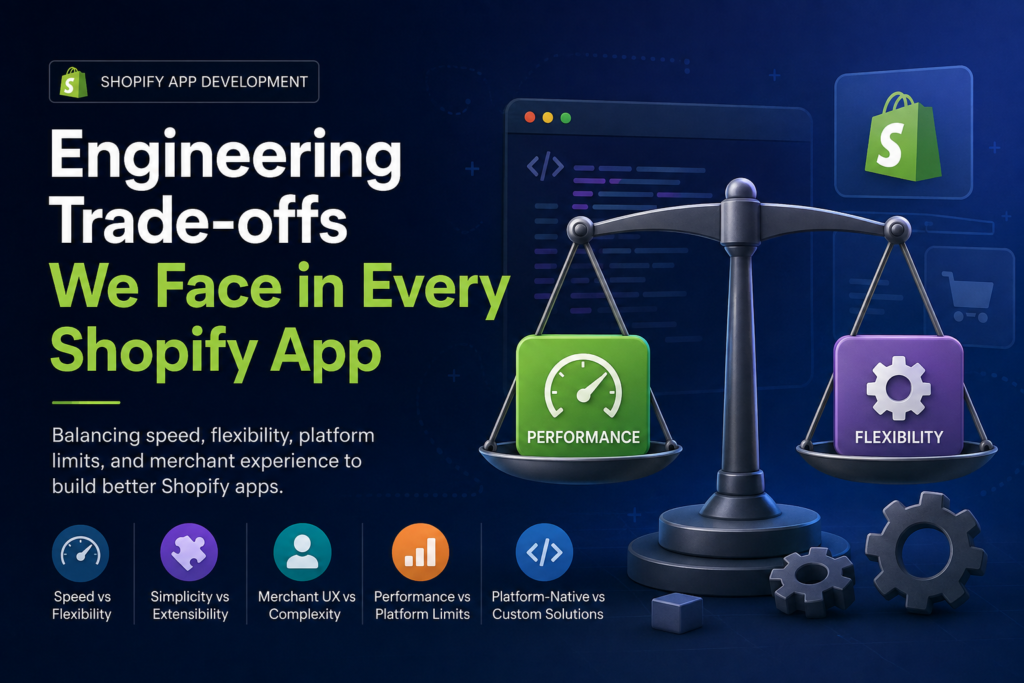
Building a Shopify app isn’t simply about implementing merchant requirements. Every feature introduces trade-offs that affect application performance, maintainability, scalability, and the overall merchant experience.
Whether you’re building an embedded Shopify app, a Shopify Function, or a Checkout UI Extension, every engineering decision has downstream consequences. Optimizing one aspect of the application often means compromising another.
After building Shopify applications across different merchant segments—from growing DTC brands to Shopify Plus stores—we’ve found that successful apps aren’t those with the most features. They’re the ones that make deliberate engineering trade-offs based on platform limitations and merchant needs.
Let’s look at the trade-offs we encounter in nearly every Shopify application.
1. Speed vs Flexibility
One of the first architectural decisions in any Shopify app is determining how much flexibility merchants actually need.
A merchant might request configurable badges, dynamic pricing rules, custom scheduling, localization, customer segmentation, and multiple display conditions. Supporting every configuration makes the product more powerful—but every additional option increases backend complexity.
Consider a promotion engine.
A lightweight implementation might evaluate only product tags and collections.
A flexible implementation could additionally evaluate:
- Customer tags
- Shopify Markets
- Company locations (B2B)
- Product metafields
- Selling plans
- Purchase history
- Inventory state
- Multiple discount priorities
Now every storefront request performs considerably more logic before producing a response.
The engineering challenge becomes balancing configuration depth against runtime performance.
Typical optimization techniques include:
- Caching merchant configuration
- Using Shopify Functions instead of external API calls where possible
- Precomputing rule evaluation
- Minimizing GraphQL requests
- Storing normalized configuration data
The objective isn’t simply to make the app configurable—it’s to ensure additional flexibility doesn’t noticeably impact the storefront experience.
2. Simplicity vs Extensibility
Shopify evolves rapidly.
Features that don’t exist today often become platform capabilities six months later.
This creates an engineering dilemma.
Should you build only today’s requirements, or prepare for future expansion?
For example, an app may initially support:
- Fixed bundles
- Percentage discounts
- Manual product selection
Later, merchants request:
- Mix-and-match bundles
- Subscription products
- AI recommendations
- Market-specific pricing
- Quantity breaks
- Customer-specific discounts
If the original implementation tightly couples pricing logic, bundle management, and merchant configuration, every new feature becomes increasingly expensive to develop.
Conversely, attempting to support every possible future scenario from day one often results in unnecessary complexity and slower delivery.
The practical approach is identifying components that are likely to evolve while avoiding abstractions that solve hypothetical problems.
Engineering effort should be invested where change is expected—not everywhere.
3. Merchant UX vs Engineering Complexity
The easiest experience for merchants usually requires the most engineering work.
Take application onboarding.
A basic installation process might require merchants to:
- Create metafields
- Configure theme app extensions
- Register webhooks
- Enable app embeds
- Configure permissions
- Create initial settings
Technically, this is straightforward.
From the merchant’s perspective, it’s frustrating.
A production-ready application often automates these steps through:
- Automatic webhook registration
- Metafield definition creation
- Intelligent default configuration
- Theme compatibility detection
- Embedded onboarding
- Configuration validation
None of these features change the app’s core functionality.
However, they dramatically reduce setup time and improve merchant adoption.
Good engineering often happens behind the scenes.
4. Real-Time Data vs Platform Limits
Merchants frequently expect live information throughout the storefront.
Examples include:
- Real-time inventory
- Dynamic pricing
- Personalized recommendations
- Shipping estimates
- Cart validation
The challenge is that Shopify APIs operate within rate limits and network latency.
Calling the Admin API repeatedly during storefront interactions isn’t practical.
Instead, developers typically combine multiple strategies:
- Webhook-driven synchronization
- Background jobs
- Cached merchant configuration
- Incremental updates
- Shopify Functions
- Storefront API where appropriate
Rather than retrieving data every time a customer interacts with the store, applications maintain synchronized datasets and update only when relevant Shopify events occur.
The result is faster customer interactions while staying within Shopify’s API constraints.
5. Embedded Admin Experience vs Backend Responsibility
Embedded apps provide a native merchant experience inside Shopify Admin.
Using App Bridge, Polaris, and the Admin API creates a seamless workflow.
However, embedding also increases backend responsibilities.
Developers must manage:
- OAuth authentication
- Session tokens
- API version updates
- Background processing
- Webhook verification
- Billing logic
- Offline access tokens
- Merchant-specific configuration
The frontend remains relatively lightweight.
Most application complexity shifts toward backend infrastructure.
This becomes especially important when supporting thousands of merchants simultaneously.
6. Faster Delivery vs Long-Term Maintenance
Every engineering team faces delivery pressure.
Merchants want features quickly.
Businesses want shorter release cycles.
Developers naturally look for the fastest implementation.
The problem is that shortcuts rarely remain isolated.
For example:
Duplicating GraphQL queries instead of creating reusable services.
Hardcoding configuration values.
Skipping validation.
Ignoring pagination.
Avoiding error recovery.
Each decision saves hours today.
Collectively, they create months of technical debt later.
Long-term Shopify applications require continuous API upgrades, compatibility testing, and feature enhancements.
Maintaining clean implementations often reduces overall engineering cost even if initial development takes slightly longer.
7. Platform-Native Solutions vs Custom Infrastructure
Shopify continues expanding platform capabilities through:
- Shopify Functions
- Checkout Extensions
- Customer Account Extensions
- Flow
- Metaobjects
- Web Pixels
- App Blocks
Developers frequently face a decision.
Should functionality be implemented using Shopify-native capabilities, or should it be handled through custom infrastructure?
Platform-native implementations generally provide:
- Better performance
- Lower maintenance
- Improved compatibility
- Reduced infrastructure costs
Custom implementations offer:
- Greater flexibility
- Advanced business logic
- Platform independence
- Support for unique merchant workflows
The decision depends on whether Shopify already provides sufficient capabilities for the merchant’s requirements.
Engineering Decisions Are Business Decisions
Engineering trade-offs aren’t purely technical.
Every decision directly affects:
- Merchant onboarding
- Storefront performance
- Infrastructure cost
- API usage
- Future feature development
- Support overhead
- Application reliability
The best Shopify engineers understand that technical excellence isn’t measured by complexity.
It’s measured by delivering reliable solutions that continue working as merchants and Shopify itself evolve.
How Tech Wishes Solutions Approaches Shopify App Development
At Tech Wishes Solutions, every Shopify app begins with evaluating constraints before writing implementation code.
We consider:
- Expected merchant scale
- Shopify API limitations
- Performance budgets
- Future platform changes
- Operational maintenance
- Merchant workflows
- Long-term extensibility
This helps us build applications that are not only functional on launch day but remain stable as merchants grow and Shopify introduces new capabilities.
Whether we’re developing embedded Shopify apps, Checkout Extensions, Shopify Functions, AI-powered commerce solutions, or Shopify Plus integrations, our engineering decisions are guided by one principle:
Build for the merchant’s real-world needs—not theoretical perfection.