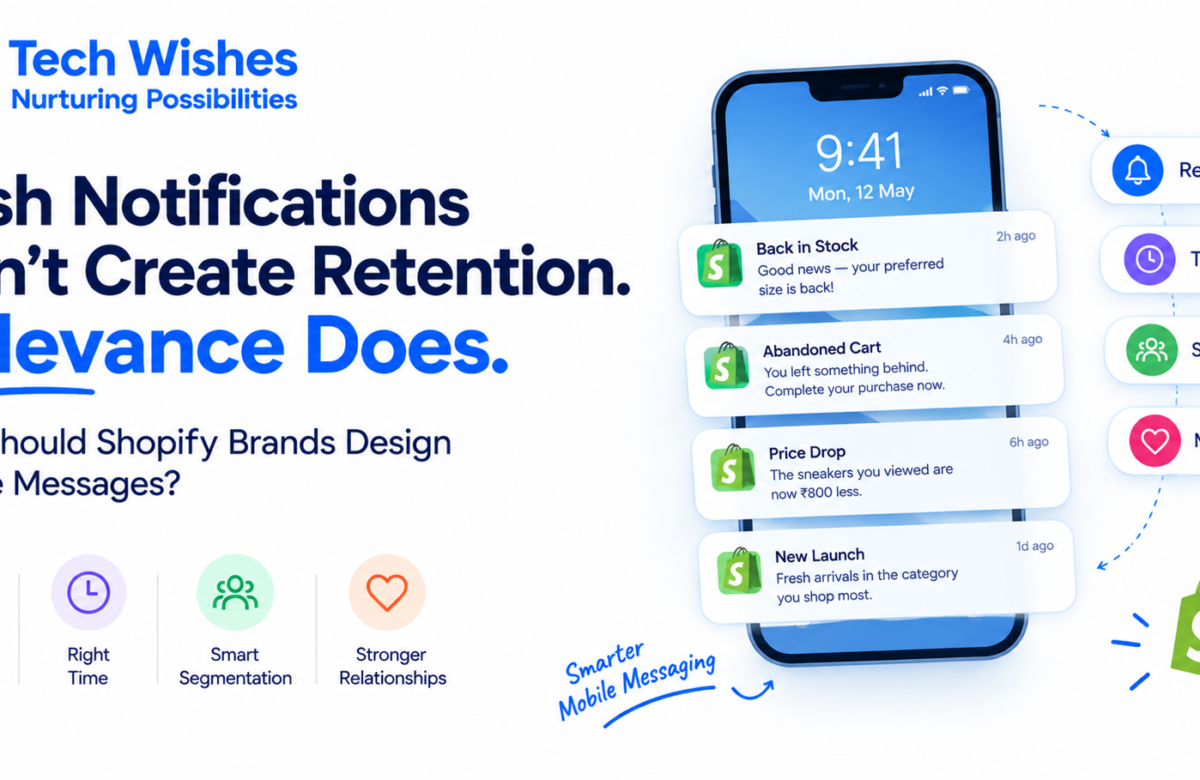

A push notification does not create customer loyalty simply because it appears on someone’s phone.
If a customer receives “20% OFF! Shop Now!” three times in a week, the message quickly becomes background noise. But a notification saying “The linen shirt you wanted is back in stock” arrives with a reason to care.
That distinction matters for Shopify brands investing in mobile commerce. Push notifications can support retention, but their value comes from relevance, timing, segmentation and the customer’s relationship with the product, not from sending more messages.
Shopify itself recommends personalising push notifications, being mindful of timing and cadence, and using shopper behaviour to make messages more relevant.
So, how should a Shopify brand actually design its mobile messaging strategy?
Start With the Customer Event, Not the Promotion
The weakest push strategy starts with:
“What should we promote today?”
A stronger one starts with:
“What happened that makes this message useful right now?”
That creates several distinct notification types.
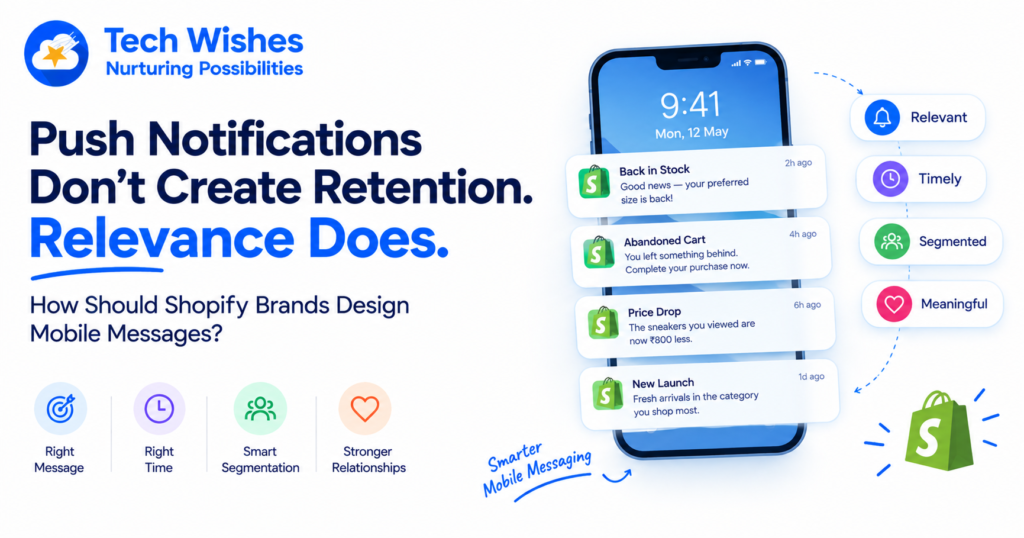
1. Back-in-Stock: Respond to Existing Intent
Someone who asked to be notified when a product returns to stock has already demonstrated interest.
A back-in-stock notification therefore has unusually strong context:
“Good news — your preferred size is back.”
This is fundamentally different from broadcasting a new product to an uninterested audience.
ShopApp Builder supports back-in-stock notifications, alongside personalised and promotional push notifications.
The strategic lesson is simple: prioritise demonstrated intent over audience size.
2. Abandoned Cart: Continue the Conversation
An abandoned-cart message also has a clear trigger: the shopper started a purchase but did not finish.
That makes it more useful than a generic reminder.
However, timing matters.
A first message can simply remind the shopper. A later message might address a relevant concern, such as availability or delivery. Discounts should not automatically be attached to every abandoned cart; otherwise customers may learn to delay purchases.
Shopify identifies abandoned-cart notifications as one use case for push messaging, alongside reminders, deals and product updates.
The objective should be to reduce friction, not train customers to wait for a coupon.
3. Price Drops: Use Previous Interest as Context
A price-drop notification becomes relevant when the customer has already shown interest in the product.
For example:
“The sneakers you viewed are now ₹800 less.”
That message has context. It does not ask the customer to discover why they should care.
Price alerts are already a common notification type within Shopify’s mobile and push ecosystem.
For brands trying to increase repeat purchases on Shopify, this kind of event-based messaging can be more useful than repeatedly broadcasting store-wide promotions.
4. New Launches: Segment Before You Send
A new-product launch should not necessarily go to every app user.
A customer who repeatedly buys skincare may be interested in a new serum. A customer who only buys men’s footwear may not care about a new women’s collection.
This is where segmentation becomes important.
Useful segments could include:
- Previous purchasers
- Product-category buyers
- High-value customers
- Recently active users
- Wishlist users
- Lapsed customers
- Customers who viewed a particular product category
Shopify’s push guidance recommends tailoring messages to audience characteristics, preferences and shopping behaviour rather than treating every subscriber identically.
5. Personalised Recommendations: Give the Message a Reason
“New products are here” is an announcement.
“New arrivals in the category you shop most” is a recommendation.
The second message has more contextual relevance.
But personalisation should go beyond inserting someone’s name. A genuinely useful recommendation can reflect browsing behaviour, purchase history, product interests or a meaningful relationship with a category.
The goal is not to make every message look personalised.
It is to make the reason for receiving the message understandable.
6. Promotions: Don’t Make Discounts Your Entire Retention Strategy
Promotions have their place.
Flash sales, seasonal events and app-exclusive offers can create legitimate urgency. ShopApp Builder supports promotional push notifications and app-only discounts, among other mobile commerce features.
But if every notification contains a discount, the brand starts teaching customers that there is little reason to buy at full price.
A healthier mix includes:
Utility → Relevance → Discovery → Promotion
not:
Discount → Discount → Discount → Discount
Frequency Is a Product Decision
There is no universal number of push notifications every Shopify store should send.
Shopify recommends monitoring engagement and adjusting cadence rather than overwhelming users, with its guidance suggesting merchants can start conservatively and learn from performance.
The right frequency depends on:
- Purchase frequency
- Product category
- Customer expectations
- Notification type
- Engagement history
- Campaign seasonality
A replenishment brand may have more legitimate reasons to communicate than a furniture store.
The important metric is not messages sent.
It is useful to measure actions generated per message without damaging engagement.
Timing Should Follow the Event
Timing is another place where brands often overgeneralize.
A back-in-stock notification should be sent when inventory actually returns.
An abandoned-cart message should follow the abandonment event.
A launch notification should align with the product becoming available.
A promotion can be scheduled around the campaign window.
Shopify specifically recommends considering time zones and using performance data to understand when audiences are most responsive.
In other words, event timing should take priority over a generic “send every evening at 7 PM” rule.
How ShopApp Builder Fits Into the Strategy
ShopApp Builder can provide the mobile infrastructure through which these messages reach app users. Its current Shopify App Store listing includes smart push notifications, back-in-stock and personalised notifications, promotional messaging, rich media, app-only discounts, cross-sells and analytics.
But the app itself is not the retention strategy.
The strategy is the logic behind the message:
Who should receive it?
Why are they receiving it?
Why now?
What action should they take?
What happens if they don’t?
That is what turns push from a broadcasting tool into a customer communication channel.
Measure Retention, Not Notification Volume
If the objective is to improve customer retention on Shopify, don’t judge the strategy only by opens or clicks.
Track:
- Repeat purchase rate
- Revenue per active app user
- Purchase frequency
- Conversion after notification
- Unsubscribe or notification opt-out rate
- Revenue by notification type
- Customer lifetime value
Most importantly, compare customers who receive particular messaging against an appropriate baseline or control group.
A notification that generates clicks but no incremental purchases may look successful in a dashboard while contributing little to the business.
The Better Mobile Messaging Framework
Before sending any push notification, ask five questions:
- Relevance: Why should this customer care?
- Intent: What behaviour triggered the message?
- Timing: Why should they receive it now?
- Frequency: Have we already contacted them too often?
- Value: What useful action can the customer take?
If those answers are weak, the notification probably should not be sent.
Mobile retention is not created by occupying more screen space.
It is created when the brand consistently gives customers useful reasons to return.
And that is the real opportunity for Shopify brands looking to improve mobile conversions, increase repeat purchases on Shopify, and build stronger customer relationships: not more push notifications, but better ones.
Frequently Asked Questions
How often should Shopify stores send push notifications?
There is no universal frequency. Start conservatively, monitor engagement and conversion, and adjust based on customer behaviour and the type of notification.
What types of Shopify push notifications work best?
Event-based messages such as back-in-stock alerts, abandoned-cart reminders and relevant price drops generally have stronger contextual intent than generic promotional broadcasts.
Can push notifications increase repeat purchases on Shopify?
They can contribute to repeat purchases when messages are relevant and timely, but retention should be measured against a baseline rather than automatically attributed to notifications.
Should every Shopify customer receive the same push notification?
No. Segmentation based on purchase history, browsing behaviour, product interests and engagement can make messages substantially more relevant.
Can ShopApp Builder send personalised push notifications?
Yes. ShopApp Builder currently supports personalised, back-in-stock and promotional push notifications, along with app-only discounts, cross-sells and other mobile commerce features.
What should I look for in Shopify app builder reviews?
Look beyond the ability to send push notifications. Evaluate segmentation, personalisation, analytics, event-based messaging, app performance, Shopify synchronisation, and the ability to connect messaging with actual customer behaviour.
Do push notifications automatically improve customer retention?
No. Push is a communication mechanism, not a retention strategy. Poorly timed or irrelevant messages can create notification fatigue. Retention comes from consistently delivering useful experiences and reasons for customers to return.