
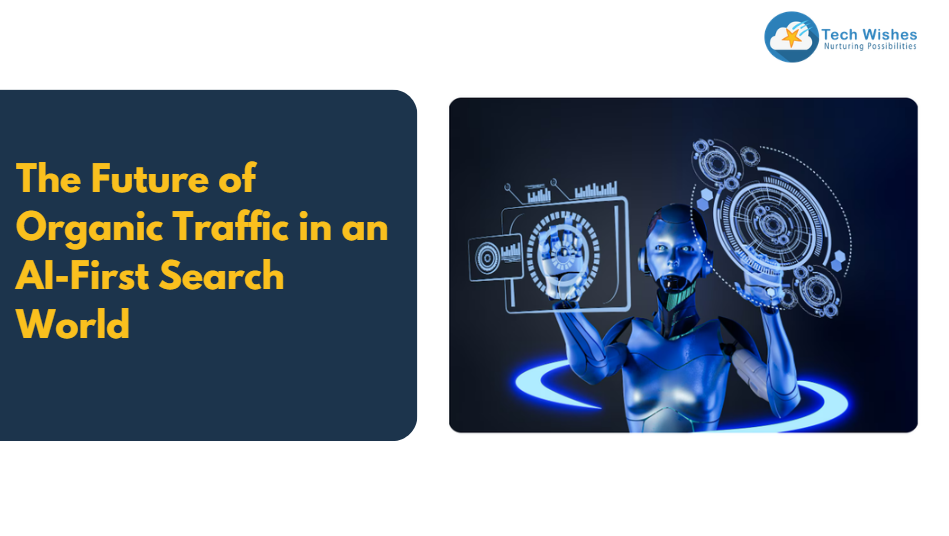
If you’ve been watching search closely, you already feel it. Fewer clicks. More zero-click answers. AI summaries are showing up before traditional results. Users get what they need without ever visiting a website.
For brands that relied on classic SEO playbooks, this feels unsettling. For others, it’s an opportunity hiding in plain sight.
At Tech Wishes, we see the shift toward an AI-first search world not as the end of organic traffic, but as a reset of what “earning attention” really means.
Search Is Moving From Discovery to Decision
Traditional search was about discovery. You searched, compared, clicked multiple links, and decided.
AI-powered search compresses that journey.
When users ask ChatGPT, Gemini, or Perplexity a question, they’re often looking for a direct answer, not a list of options. That changes how organic traffic is distributed.
Traffic is no longer spread evenly across page one. It’s concentrated around a smaller set of trusted sources.
This means fewer clicks overall, but higher-quality visibility for brands that earn trust.
Also Read – Is SEO Still Relevant in Digital Marketing?
Ranking Is No Longer the Only Goal
For years, SEO success meant rankings. Position one. Featured snippets. Page-one dominance.
In an AI-first search environment, visibility doesn’t always look like a click. It looks like a citation, a reference, or a summarised insight pulled directly from your content.
That means brands need to think beyond rankings and focus on being included in answers.
If AI trusts your content, your brand still wins—even if the click doesn’t happen immediately.
Authority Is Replacing Keywords as the Core Signal
Keywords still matter. But they’re no longer the main signal.
AI systems look for topical authority. They learn which brands consistently explain certain subjects well. Over time, patterns emerge. Some sources become “safe.” Others fade into noise.
This is why shallow content strategies struggle now.
Brands that publish deep, experience-backed content across related topics are far more likely to be referenced by AI systems than those chasing isolated keywords.
Content That Teaches Will Outperform Content That Sells
AI search engines are trained on helpfulness, not persuasion.
Overly promotional content rarely surfaces in AI-generated answers. Clear explanations, balanced viewpoints, and practical insights do.
This is where content marketing needs a mindset shift.
Instead of asking “How do we rank for this keyword?” the better question is “How do we explain this better than anyone else?”
Brands that teach build trust. Trust earns visibility.
Also Read – Why Partnering with a Shopify Expert Can Boost Your SEO Performance
Zero-Click Doesn’t Mean Zero Impact
There’s a misconception that if users don’t click, organic traffic has no value.
That’s not entirely true.
Brand awareness, authority, and recall still increase when your brand appears in AI-generated answers. The customer journey just becomes longer and less linear.
Users may not click today, but they remember names that show up consistently. When buying intent appears later, those brands feel familiar.
Organic traffic is evolving from immediate conversion to long-term influence.
Technical Foundations Still Matter
Even in an AI-first world, weak foundations hurt.
Poor site structure, slow load times, messy content formatting, and unclear authorship all reduce trust signals. Technical SEO now supports credibility rather than rankings alone.
AI systems favour content that is easy to parse, well-structured, and clearly authored by knowledgeable sources.
Good infrastructure doesn’t guarantee visibility—but bad infrastructure almost guarantees invisibility.
Brand Mentions Will Matter More Than Ever
Backlinks aren’t disappearing, but brand mentions are becoming equally important.
AI systems look for consistency across the web. When multiple credible sources reference your brand in similar contexts, trust builds.
This means PR, thought leadership, podcasts, partnerships, and community presence all feed into organic visibility indirectly.
SEO is no longer confined to your website.
The Brands That Win Will Think Long-Term
The future of organic traffic isn’t about volume. It’s about relevance.
Fewer clicks. Better intent. Stronger trust.
Brands that adapt will focus on:
- Building depth, not breadth
- Publishing consistently, not sporadically
- Explaining clearly, not optimising aggressively
- Thinking in systems, not tactics
At Tech Wishes, we help brands prepare for this shift by aligning SEO, content strategy, and digital infrastructure with how AI-driven search actually works.
Final Thought: Organic Traffic Isn’t Ending—It’s Maturing
The era of easy clicks is fading.
The era of earned trust is beginning.
In an AI-first search world, organic traffic belongs to brands that educate, clarify, and contribute meaningfully to conversations.
It’s harder work. Slower work. More thoughtful work.
But it’s also more sustainable.
And the brands that adapt now won’t just survive the future of search.
They’ll shape it.