
A Shopify mobile app should not be justified because “mobile is growing” or because competitors have one. The better question is much harder:
How many incremental purchases would the app need to generate before its investment pays back?
That turns a mobile app from a branding decision into a measurable commerce decision.
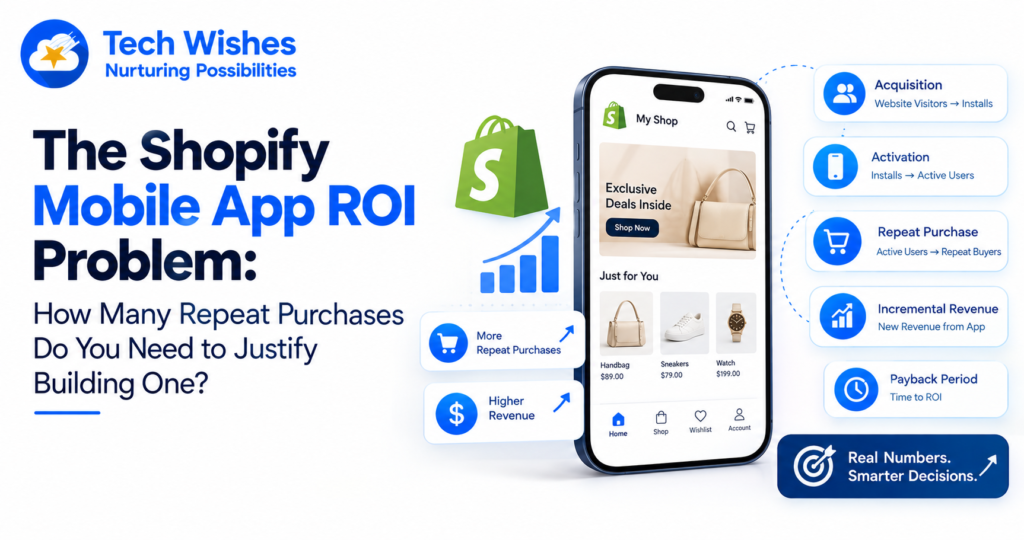
For a Shopify merchant, the calculation should connect app development cost → acquisition → install rate → active users → repeat purchase rate → incremental revenue → payback period.
That framework also makes it easier to decide whether building a custom app makes sense or whether a Shopify mobile app builder is the more practical route.
Start With the Investment, Not the App
The first number is your total app investment.
This is broader than development.
Depending on the approach, it can include:
- App development or platform fees
- Shopify integration work
- App Store and Google Play costs
- Design and testing
- App launch campaigns
- Install incentives
- Ongoing maintenance
- Push notification or engagement costs
For example, assume a merchant spends $20,000 on initial development and launch.
That $20,000 becomes the amount the app needs to recover through incremental contribution, not simply total sales generated through the app.
That distinction is critical.
If a customer would have purchased from your website anyway, moving that transaction into the app does not necessarily represent incremental revenue.
Step 1: Calculate How Many Customers You Can Acquire
Next, estimate your realistic app acquisition pool.
Suppose your Shopify store receives 100,000 monthly mobile visitors.
You cannot assume all of them will install the app.
Instead, model an install rate.
For example:
100,000 mobile visitors × 3% install rate = 3,000 installs
The 3% figure here is only an illustrative assumption. Your actual rate should come from your app promotion strategy and historical campaign performance.
This is where acquisition matters.
A beautifully built app with no effective installation strategy can produce very little financial return.
Step 2: Installs Are Not Active Users
This is where many mobile-app ROI calculations become overly optimistic.
An install is not a customer relationship.
Some users will install the app once and never open it again. Others will browse occasionally. A smaller group may become genuinely active shoppers.
Suppose:
3,000 installs × 60% activation rate = 1,800 active users
Your definition of “active” should be established before measurement. It could mean opening the app within a defined period, browsing products, adding to cart or completing another meaningful action.
ShopApp Builder, for example, provides features such as analytics, predictive search, wishlist functionality and push notifications designed around engagement and mobile shopping behaviour.
The important point is not the feature list. It is whether those features create measurable behaviour that eventually leads to additional purchases.
Step 3: Measure Repeat Purchase Behaviour
Now comes the number that matters most for a retention-led app strategy:
How many active users purchase again?
Shopify defines repeat purchase rate as the percentage of customers who make more than one purchase, making it an important metric to evaluate alongside conversion rate.
Imagine your 1,800 active users generate:
1,800 × 30% repeat purchase rate = 540 repeat purchasers
But don’t automatically attribute all 540 purchases to the app.
You need a control or baseline.
If comparable customers on your mobile website already have a 25% repeat purchase rate, the app’s potential incremental lift is closer to the difference between 30% and 25%, not the entire 30%.
That is the difference between app revenue and incremental app revenue.
Step 4: Calculate Incremental Revenue
Suppose your 540 app repeat purchasers generate an average incremental order value of $60.
That gives:
540 × $60 = $32,400 incremental revenue
But revenue still isn’t the final ROI number.
If your contribution margin after product costs, discounts, shipping and other variable costs is 40%, then:
$32,400 × 40% = $12,960 incremental contribution
If the total investment was $20,000, you have not yet reached payback.
You would need another $7,040 in contribution before the original investment is recovered.
This is a much more useful way to evaluate whether an app can increase repeat purchases on Shopify.
Step 5: Calculate the Payback Period
The final calculation is straightforward:
Payback Period = Total App Investment ÷ Monthly Incremental Contribution
If the app generates $4,000 in incremental contribution per month:
$20,000 ÷ $4,000 = 5 months
Your estimated payback period is five months.
After that point, incremental contribution can begin contributing positively to the original investment, assuming the underlying economics remain stable.
What Can Improve the Numbers?
This is where the app experience matters.
You can improve the economics by increasing:
Install rate: Make app acquisition part of your existing customer journey.
Activation: Give users a reason to return rather than treating installation as the goal.
Conversion: Reduce friction in browsing, search, checkout and account experiences to improve mobile conversions.
Repeat purchase rate: Use relevant push notifications, product discovery, wishlists, promotions and post-purchase engagement.
Order value: Cross-sell and recommend relevant products where appropriate.
ShopApp Builder includes push notifications, abandoned-cart notifications, app-only discounts, cross-sell functionality, predictive search and wishlists.
The strategic question is which of these mechanisms actually changes your numbers.
When Does a Mobile App Make Financial Sense?
A mobile app becomes more compelling when three conditions exist.
You have enough repeat-purchase potential.
A replenishment, fashion, beauty, food or lifestyle brand may have more opportunities for repeat behaviour than a business where customers purchase once every several years.
You already have meaningful mobile traffic.
The larger your qualified mobile customer base, the larger the potential acquisition pool.
You have a reason for customers to return.
An app should create a better retention mechanism, not simply reproduce your website inside an icon.
This is why merchants comparing Shopify app builder reviews should look beyond design templates. Evaluate analytics, push capabilities, Shopify synchronisation, product discovery, customer accounts and the tools available to drive repeat behaviour. Shopify’s current mobile-app-builder marketplace contains more than 100 apps, so feature depth and commercial fit matter when comparing options.
Where ShopApp Builder Fits
ShopApp Builder is designed to turn a Shopify store into a branded Android and iOS shopping app without requiring merchants to build the entire mobile infrastructure themselves. Its Shopify App Store listing currently shows a $99/month plan, a 14-day free trial, real-time store synchronisation, push notifications, predictive search, wishlist functionality and app analytics.
That creates an alternative to treating mobile app development as a large upfront engineering project.
But the ROI framework stays the same.
The cheaper app is not automatically the better investment. The better investment is the one that generates enough incremental contribution to justify its total cost.
The Bottom Line
Don’t ask:
“Should my Shopify store have an app?”
Ask:
“What would have to change in customer behaviour for an app to pay for itself?”
Model the funnel from acquisition to installs, active users, repeat purchases and incremental contribution. Then calculate the payback period.
If the numbers work, a mobile app can become a meaningful retention channel and help you improve customer retention on Shopify.
If they don’t, spending more on app development will not solve the underlying economics.
The smartest mobile strategy starts with the business case—not the app.
Frequently Asked Questions
How do I calculate Shopify mobile app ROI?
Calculate total app investment, then estimate incremental users, active users, repeat purchases, incremental order value and contribution margin. Compare the resulting incremental contribution against the investment.
How many repeat purchases justify a Shopify mobile app?
There is no universal number. It depends on development cost, acquisition cost, average order value, contribution margin and the incremental repeat purchase rate generated by the app.
Should I compare app revenue with website revenue?
Not directly. The important metric is incremental revenue—sales that would not have happened without the app.
Is a Shopify mobile app worth it for a low-repeat-purchase business?
It can be, but the economics are usually harder to justify if customers naturally purchase infrequently. Calculate the expected customer lifetime and realistic repeat-purchase opportunity before investing.
Can a Shopify mobile app improve customer retention?
Potentially. Features such as push notifications, wishlists, personalised engagement and easier mobile shopping can create additional opportunities for customers to return. The actual retention impact should be measured against a baseline rather than assumed. ShopApp Builder supports several of these engagement features.
Should I build a custom app or use a Shopify app builder?
Compare the total cost and required functionality. A custom build may make sense when you need highly specific workflows or experiences. A Shopify app builder can be more practical when your priority is launching a branded shopping app with established mobile commerce capabilities quickly.