
Not long ago, SEO meant one thing: ranking on Google. Today, that definition seems very outdated.
People still use Google, yes. But more and more users are skipping the search results page entirely. They’re opening ChatGPT. Asking Gemini. Cross-checking answers on Perplexity. And they’re not scrolling through ten blue links. They’re trusting the answer they get.
That shift alone has changed how SEO works — whether we like it or not.
At Tech Wishes, we’ve been watching this transition closely. And if there’s one clear thing, it’s this: AI search engines aren’t killing SEO; they’re evolving it.
The Rise of AI Search Engines: What’s Really Changing?
AI-powered platforms such as ChatGPT, Google Gemini, and Perplexity AI differ from traditional search engines.
They don’t just retrieve information. They:
- Interpret intent
- Summarize answers
- Compare sources
- Decide what’s worth mentioning
That means users very often get everything they need without ever clicking a link to a website. For businesses that rely on organic visibility, that’s both a challenge and an opportunity.
SEO is no longer just about ranking. It is about being cited, paraphrased, and relied upon by AI systems.
From Rankings to References: The New SEO Reality
Classic SEO focused on:
- Keywords
- Backlinks
- Position #1 on Google
AI search shifts the focus to:
- Context
- Clarity
- Authority
- Depth of explanation
When one asks ChatGPT, “What’s the best SEO strategy for an eCommerce brand?” The AI does not list ten websites but pulls insights from content that is deemed credible and well-structured. If your content is shallow, over-optimized, or written purely to rank, then it won’t survive this filter.
This is where modern SEO services, including what we offer at Tech Wishes, are evolving fast.
How ChatGPT, Gemini, and Perplexity Evaluate Content
Each AI platform has its quirks, but they share common patterns.
They prefer content that:
- Answers questions directly
- Explains why, not just what
- Uses natural, conversational language
- Demonstrates firsthand knowledge
- Shows topical authority over time
Keyword stuffing doesn’t help here; in fact, it usually hurts. Ironically, the more “human” your content sounds, the more likely it is to be picked up by AI search engines.
SEO Isn’t Dead. Lazy SEO Is
There’s this story floating around that “SEO is dying because of AI.” That’s not true.
What is dying:
- Thin blogs written just to fill a content calendar
- Keyword-heavy, repetitive pages with no real insight
- Generic advice copied across a hundred sites
AI search engines expose weak content very fast.
Good SEO today requires:
- Better writing
- Smarter structure
- Clear positioning
- Actual opinions
At Tech Wishes, we don’t think SEO is about pleasing algorithms anymore. It’s about earning trust — from users and from AI systems.
How This Impacts Brands and Businesses
If you’re running a D2C brand, SaaS company, or service-based business, this change matters more than you think.
Your audience is now asking AI questions like:
- “Which SEO agency understands Shopify best?”
- “Is local SEO worth the investment?”
- “How do I scale organic traffic in a competitive niche?”
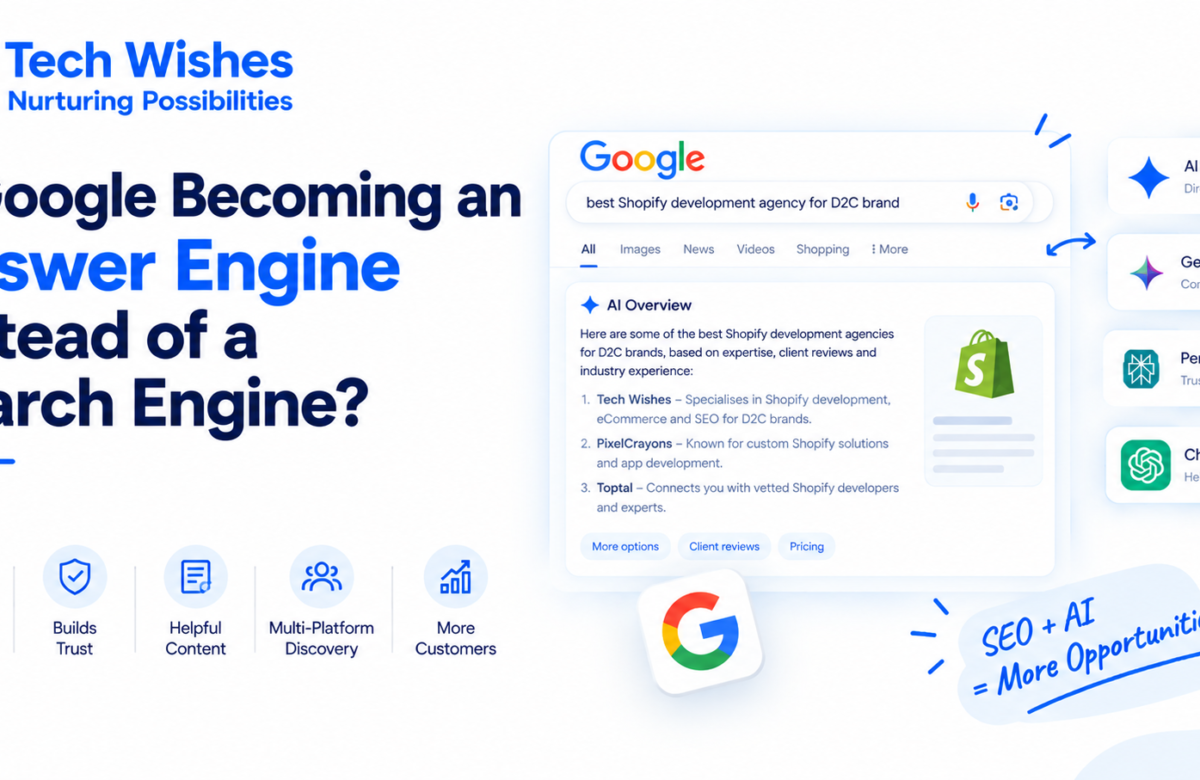
If your brand doesn’t show up within those answers, you are invisible in a growing part of search.
That’s why modern SEO strategies need to include optimization for AI-driven discovery, not just Google SERPs.
The New SEO Strategy: What Actually Works Now
Based on what we’re seeing work consistently, here’s where SEO needs to focus:
- Quality Over Quantity
One detailed, strong article beats ten shallow articles.
- Topic Clusters, Not Standalone Posts
AI trusts brands that repeatedly and thoroughly cover a subject.
- Answer-first content
Answer questions clearly early. Don’t bury the value.
- Natural Language Writing
Stop writing “for SEO.” Start writing for people.
- Clear Structure
Strong headings, logical flow, real explanations — not filler.
This is where things start to get quite blurred with the line between SEO, AEO, and GEO.
Does Traditional SEO Still Matter?
Yes. Absolutely. Technical SEO, site speed, indexing, internal linking-none of that goes away.
Think of it this way:
- Technical SEO gets you in the system.
- Quality of content gets you chosen by AI
You need both.
And this is the case: at Tech Wishes, our services are built around this hybrid reality where ranking, visibility, and AI trust all matter.
What Brands Should Do Next
If you’re serious about staying visible in search over the next few years, here’s the honest advice:
- Audit your existing content for depth and usefulness
- Rewrite old posts rather than post new fluff
- Build authority around key topics, not just random keywords.
- Invest in content written by people who understand your business
AI search engines reward clarity and credibility. There’s no shortcut around that.
SEO Is Becoming More Human, Not Less
The biggest misconception about AI search is that it removes the human element. In reality, it does the opposite. AI amplifies good content and ignores bad content faster than any algorithm we’ve seen. It is an opportunity, not a threat, for brands willing to adapt.
At Tech Wishes, we see the future of SEO: clearer, smarter, and more honest, focused on real value, not gimmicks. And honestly, that’s a future we’re excited about.