
For a long time, Shopify development followed a familiar pattern. A merchant needed a feature, a theme customization, or a custom app, and a developer built exactly what was requested. The project was delivered, the invoice was paid, and everyone moved on.
That model worked when Shopify stores were relatively simple.
Today, ecommerce looks very different.
Merchants are no longer managing just an online store. They’re operating connected commerce ecosystems with inventory systems, fulfillment partners, subscription platforms, marketing automation, customer data platforms, AI tools, and multiple sales channels. Every new feature has the potential to affect several other systems.
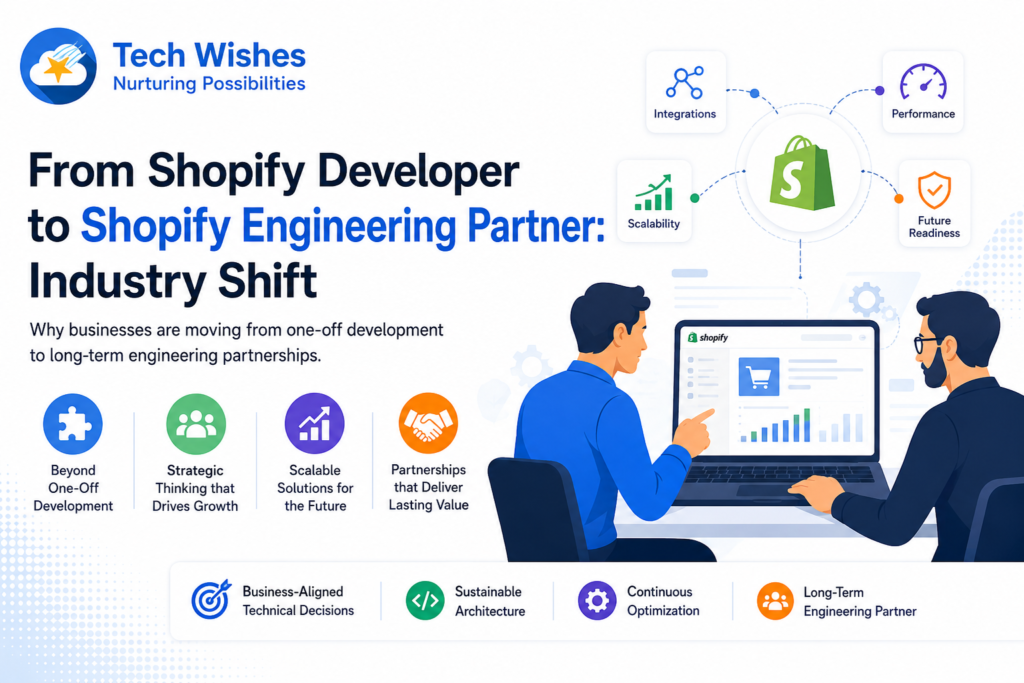
As a result, the industry is shifting away from hiring developers for isolated tasks and toward building long-term relationships with engineering partners.
The question is no longer:
“Can you build this?”
It’s becoming:
“How should we build this so it continues to support the business two years from now?”
Shopify Projects Have Outgrown One-Off Development
As businesses grow, their technical requirements become more complex.
Launching a Shopify store is often only the first milestone. Growth usually introduces new challenges:
- Connecting ERP and inventory systems
- Supporting international markets
- Building custom checkout experiences
- Integrating multiple third-party platforms
- Improving performance during high-traffic events
- Creating custom merchant workflows
- Scaling internal operations
None of these problems exist in isolation.
A new integration might affect inventory synchronization. A checkout customization could impact existing apps. A migration may require data validation, SEO preservation, and operational planning—not simply moving products from one platform to another.
Development has become part of a much larger engineering process.
Merchants Are Looking for Strategic Thinking
Writing code is still important.
But merchants increasingly value developers who can answer questions before development even begins.
Questions like:
- Is custom development actually necessary?
- Can Shopify’s native capabilities solve this?
- How will this affect future upgrades?
- What happens if the business doubles in size?
- Will this architecture be easy to maintain?
- What technical debt are we creating today?
These conversations help businesses avoid expensive rebuilds later.
Increasingly, merchants expect technical partners to contribute ideas, identify risks, and recommend better approaches—not simply execute requirements.
Digital Transformation Doesn’t End at Launch
Many businesses view Shopify implementation as part of a broader digital transformation rather than a standalone website project.
Launching the storefront is only one phase.
After launch comes:
- Continuous optimization
- Performance improvements
- Feature iterations
- Platform updates
- System integrations
- Operational improvements
- International expansion
- New sales channels
This ongoing work requires someone who understands both the technology and the business objectives.
That’s where long-term engineering partnerships create value.
The Cost of Short-Term Decisions
- Many ecommerce businesses have experienced the downside of purely transactional development.
- Features are built quickly without considering future requirements.
- Integrations are added without documentation.
- Apps duplicate existing functionality.
- Custom code becomes difficult to maintain.
- Eventually, every new feature becomes slower, riskier, and more expensive to deliver.
- Technical debt doesn’t appear overnight—it accumulates gradually through dozens of isolated development decisions.
- Engineering partners focus on reducing that debt instead of adding to it.
Shopify’s Ecosystem Is Evolving Faster Than Ever
Shopify introduces new capabilities every year.
From Shopify Functions and Checkout Extensibility to Markets, B2B features, AI-powered tools, and improvements to the GraphQL APIs, the platform continues to evolve rapidly.
Features that once required extensive custom development are increasingly becoming native capabilities.
That changes the role of developers.
Instead of building everything from scratch, engineering partners evaluate whether to:
- Build custom functionality
- Extend Shopify’s native features
- Replace existing custom code
- Wait for upcoming platform capabilities
Making the right decision can save merchants significant development and maintenance costs over time.
Migration Projects Reflect the Shift
Platform migration projects are another example of this change.
A successful migration is no longer about transferring products and customers from one platform to another.
It involves:
- Technical planning
- Data validation
- Systems integration
- SEO preservation
- Performance optimization
- Operational continuity
- Future scalability
Merchants increasingly choose implementation partners who can guide the entire transformation instead of simply completing the migration itself.
The technical implementation is only one part of a much larger business initiative.
What This Means for Shopify Professionals
For developers, this industry shift changes what clients value most.
Technical expertise remains essential, but it is increasingly combined with:
- Solution architecture
- Systems thinking
- Business understanding
- Integration planning
- Performance optimization
- Communication with stakeholders
- Long-term technical strategy
Developers who understand both commerce and engineering are becoming trusted advisors rather than implementation resources.
What Defines an Engineering Partner?
An engineering partner delivers code, but that’s only part of the relationship.
They also help businesses:
- Plan technical roadmaps
- Design scalable architectures
- Recommend platform capabilities
- Reduce technical debt
- Improve operational efficiency
- Evaluate build-versus-buy decisions
- Support continuous platform evolution
The focus shifts from completing projects to improving the overall commerce platform.
Success is measured not only by what gets built today, but by how easily the business can adapt tomorrow.
Companies like Techwishes exemplify this role by acting as true engineering partners rather than just development vendors. Their approach centers on understanding the full commerce ecosystem, aligning technical decisions with business goals, and building scalable Shopify solutions that evolve alongside the merchant. Instead of delivering isolated features, Techwishes focuses on long-term architecture, system integrations, and continuous optimization—helping businesses reduce technical debt while preparing for future growth.