
In the early days of e-commerce, automation was simple. Orders moved into spreadsheets. Inventory alerts sent emails. Tags were applied. Tasks were completed. It saved time, but it didn’t understand the business. If a customer uploaded a photo of a damaged product, the automation tool stopped.
If demand suddenly spiked or a competitor changed pricing, nothing adapted.
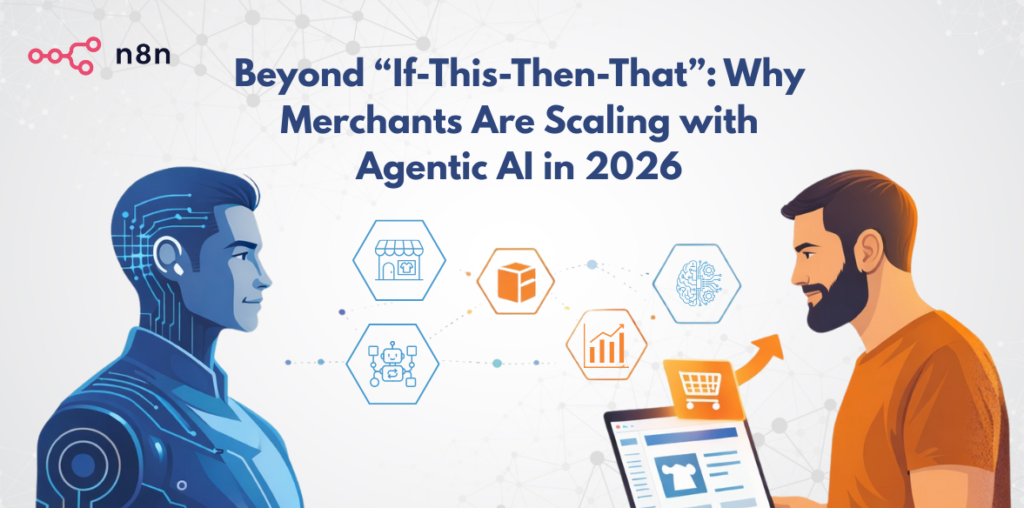
Every exception still required a human to step in and decide what to do next. As we move through 2026, this model is quietly becoming obsolete. Merchants are shifting from rigid systems to AI workflow automation, systems that can observe context, reason across data, and act with intent. Not as replacements for teams, but as force multipliers that remove operational drag.
From Automation to Agency: What “Agentic AI” Really Means
Not all AI-powered systems are equal. Traditional workflow automation tools follow predefined paths. When conditions change, they break or escalate everything to humans.
Agentic systems work differently –
- They observe signals across tools and data
- Choose between multiple possible actions.
- Adapt workflows without hard-coded branches
- Escalate uncertainty before damage occurs.
In commerce, this distinction matters –
Merchants don’t struggle because they lack tools.
They struggle because their tools don’t think together.
This is why platforms like n8n are increasingly being used, not just as an AI automation platform, but as the decision layer connecting operations, marketing, and customer experience.
Practical Use Cases: Where AI for Workflow Automation Delivers Real Value
This isn’t about magic. It’s about leverage.
The “Visual-to-Listing” Content Factory
Launching new products is rarely blocked by creativity , it’s blocked by execution.
Writing descriptions, SEO metadata, and alt text for dozens of SKUs can consume days, even with a basic no-code automation tool.
How it works
- A merchant uploads product images to a structured folder.
- An AI agent analyzes visual attributes, such as fabric, fit, and style.
- It applies AI for workflow automation by cross-referencing brand tone and SEO keywords.
- Draft product titles, descriptions, meta descriptions, and alt text
Control matters
Listings are queued for human review before publishing, ensuring brand consistency.
Outcome
What once took days becomes a focused 10–15 minute editorial review, powered by modern AI automation tools.
Predictive Inventory Planning (Not Just Alerts)
Most automation tools tell you when you’re already out of stock.
Agentic workflows look ahead.
Signals monitored
- Inventory levels
- Sales velocity
- Seasonality
- External demand indicators
What changes
Instead of reactive alerts, an AI automation service evaluates risk early, drafts a purchase order, and notifies teams before revenue is lost.
Outcome
Fewer missed sales, less dead stock, and smarter cash-flow decisions without spreadsheet firefighting.
The “VIP White-Glove” Customer Experience
Personalization usually breaks at scale, especially with rigid workflow automation tools.
Agentic systems are designed for nuance.
Trigger
An order crosses a high-value threshold.
Workflow
- An AI agent reviews purchase history and preferences.
- Drafts a personalized message in the brand’s voice
- Suggests a relevant add-on or care recommendation
Governance
Actions can be auto-approved or routed for review based on confidence levels.
Outcome
High-value customers feel genuinely recognized, without increasing operational load.
Why n8n Fits Modern AI Automation Needs
Many merchants start with a no-code automation tool, and for linear tasks, that works.
The limitation appears when workflows need:
- Memory and context
- Custom logic
- Predictable costs at scale
- Clear approval boundaries
This is where an extensible AI automation platform becomes essential.For simple automations, legacy tools are fine.
The break happens when workflows need judgment, not just execution.
The Bigger Shift: From Doer to Director
The goal of AI workflow automation isn’t to replace teams.
It’s to change how teams work.
When merchants stop manually executing workflows and start directing intelligent systems, they reclaim mental space for strategy, brand building, and growth decisions , the work that actually compounds.
What’s Next?
Scaling today isn’t about adding more tools.
It’s about building systems that adapt as your business evolves.
We help ecommerce teams design and deploy agentic systems using AI automation tools and AI automation services, tailored to how their operations truly run.
If you’d like:
- A step-by-step technical breakdown of the Visual-to-Listing Shopify workflow
- Or a guide to self-hosting your AI automation platform for full data privacy
Just say the word.