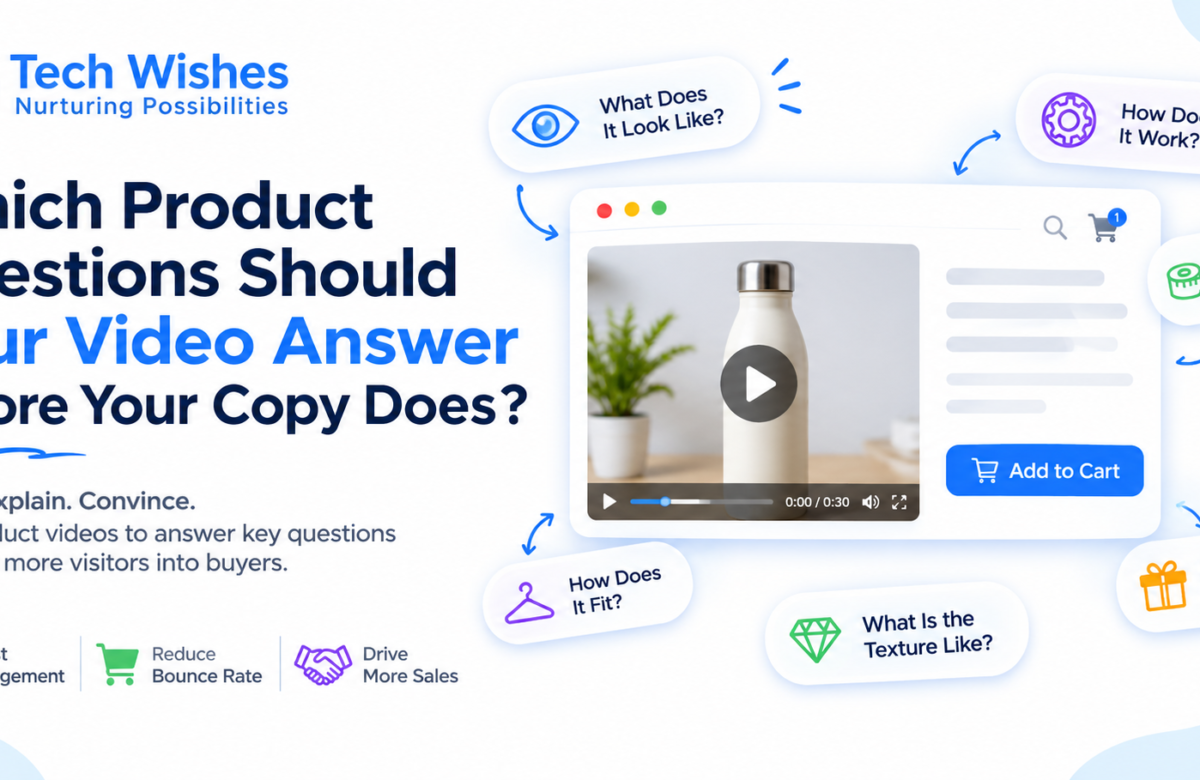

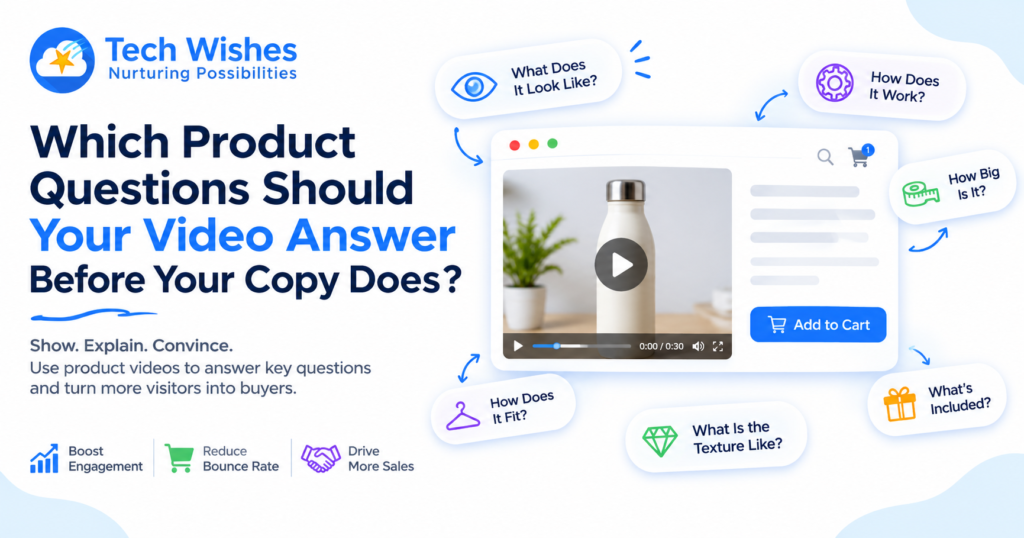
A good ecommerce product video should answer the questions shoppers need to see, not read: How does it work? What does it really look like? How big is it? How does it fit? What will using it feel like? Product copy can handle specifications, ingredients, compatibility, shipping and detailed information. Video should remove the uncertainty that words and static images often cannot.
That is the real value of product videos on Shopify. Not simply making a product page look modern, but helping shoppers understand the product faster and buy with greater confidence.
Start With What Customers Actually Ask
Before creating a video, look at your customer reviews, support tickets, live chats and FAQs.
You may find questions like:
- Does it fit true to size?
- How does it work?
- Is the material thick or lightweight?
- What does the colour look like in natural light?
- How much can it hold?
- What does it look like from the side?
- How is it different from the other version?
These are excellent video content ideas because many aren’t really asking for information. They’re asking for proof.
And proof is where video wins.
1. “What Does It Actually Look Like?”
Product photography is carefully controlled. That’s useful, but customers also want context.
Show the product from different angles. Show it in someone’s hands. Show its actual scale. Show how it looks under normal lighting.
For fashion, show movement. For furniture, show it in a real room. For beauty products, show texture and application.
The shopper should finish the video with a clearer mental picture of the product.
2. “How Does It Work?”
For functional products, demonstration is often more powerful than explanation.
A paragraph can explain how a collapsible storage product works. A video can show someone opening, collapsing and storing it in seconds.
That’s not about replacing copy. It’s about using product demonstration videos where demonstration is simply the better communication format.
3. “How Big Is It?”
Dimensions matter, but numbers don’t always create a sense of scale.
A product described as 30 cm wide doesn’t necessarily help shoppers visualise 30 cm.
Put it beside a familiar object. Show someone holding it. Place it in its intended environment.
This is particularly useful for furniture, bags, kitchen products, electronics and home accessories.
Scale is something customers understand visually.
4. “How Does It Fit?”
For apparel and accessories, fit can be a major purchase barrier.
A size chart provides measurements. Video shows the garment moving on an actual person.
You can demonstrate length, stretch, draping, movement and layering.
This doesn’t replace a size guide. It makes the guide easier to understand.
5. “What Is the Texture Like?”
Words such as “soft,” “smooth,” “matte”, and “premium” are subjective.
A close-up video can show fabric movement, surface finish, thickness, shine or texture naturally.
For fashion, beauty, homeware and lifestyle ecommerce, this can be especially useful.
You’re giving customers visual evidence rather than asking them to trust an adjective.
6. “What Happens When I Use It?”
This is where some of the strongest ecommerce product videos are created.
Don’t simply show the product. Show it solving the problem.
A water bottle being used during a workout. A kitchen tool preparing food. A skincare product being applied. A travel bag being packed.
Customers aren’t really buying the object. They’re buying what the object helps them do.
Your video should make that connection obvious.
7. “What’s Included?”
Unboxing footage can answer surprisingly important questions.
If a product comes with accessories, attachments, cables, storage cases or additional components, show them.
This removes uncertainty and prevents customers from making assumptions about what comes with their purchase.
Sometimes the most useful video isn’t the most exciting one. It’s the one that answers the question customers have just before buying.
8. “How Is This Different?”
If you sell several similar products, show the differences.
Size. Colour. Features. Capacity. Attachments. Use cases.
Product comparison videos can complement comparison tables and written specifications. Video creates quick understanding; copy provides precision.
Don’t Make Video Repeat Your Copy
Here’s a simple test:
If customers can get the same information by reading the paragraph underneath, why does the video exist?
If your copy says:
“Water-resistant nylon backpack with padded laptop compartment.”
Don’t make a video displaying those same words.
Show water hitting the material. Open the laptop compartment. Put a laptop inside. Show the padding.
Now the video has added information.
That’s what brands should aim for.
Your Best Video Ideas Are in Your Customer Data
One of the smartest ways to decide what to film isn’t brainstorming. It’s listening.
Look at:
Reviews → support questions → returns → product comparisons → on-site searches → FAQs.
If customers repeatedly ask whether a product fits a particular use case, that’s probably a video opportunity.
If customers say a product looked different from what they expected, that’s an even stronger signal.
Your customers are effectively telling you what your product page isn’t explaining well enough.
What About SEO?
Video shouldn’t mean removing written content.
Google recommends providing relevant textual context and structured data for eligible videos and products, while videos can appear across multiple search surfaces.
The better strategy is to make video and product copy complementary.
Copy answers:
What is it?
Video answers:
What does it actually look and feel like in use?
Reviews answer:
Can I trust it?
FAQs answer:
What else should I know?
Together, they create a much stronger product experience.
Measure More Than Video Views
A product video isn’t successful simply because thousands of people watched it.
Track what happens after the view:
- Video play rate
- Completion rate
- Add-to-cart rate
- Product-page conversion rate
- Revenue per visitor
- Return rate
- Engagement by device
Then test different approaches.
Does a demonstration outperform lifestyle footage? Does showing scale outperform a feature close-up?
The answer will vary by product.
That’s why video CRO should be based on your own customer behaviour rather than generic benchmarks.
The Best Product Video Answers One Question Well
You don’t need to explain everything in 15 seconds.
You need to remove one meaningful piece of doubt.
If a shopper finishes the video thinking, “Now I get it,” you’ve created something valuable.
At Tech Wishes, solutions such as Glow Videos help Shopify brands bring short-form, product-focused video into the shopping experience, making visual content more useful at the point where customers are deciding whether to buy.
Because the best product video isn’t necessarily the one with the biggest production budget.
It’s the one that answers the question standing between “I like this” and “I’ll buy this.”
FAQs
Should every product have a video?
No. Video is most valuable when seeing the product in action adds information that images and text cannot communicate efficiently.
Can product videos replace product descriptions?
No. Product videos and descriptions have different jobs. Keep copy for specifications and detailed information, and use video for demonstrations and visual proof.
How long should an ecommerce product video be?
There is no universal length, but 15–30 seconds can work well for a focused demonstration. Complex products may need longer.
Can product videos reduce returns?
They can help when they clarify fit, size, appearance or functionality, reducing the gap between customer expectations and the actual product.
Where should brands find product video ideas?
Start with customer reviews, support tickets, FAQs, returns and on-site searches. Repeated customer questions are often your best video topics.