
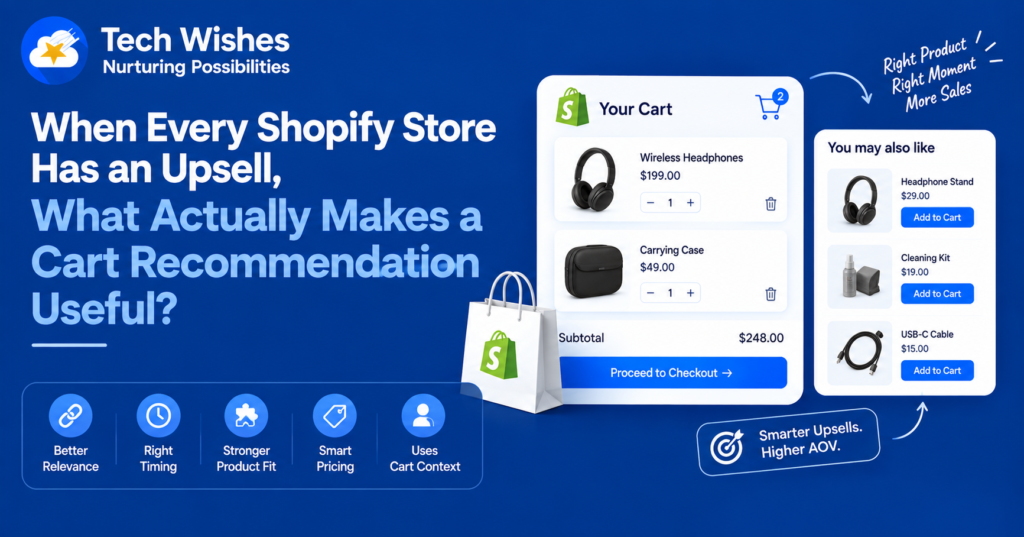
Adding an upsell to the cart is easy. Making that upsell genuinely useful is much harder.
A Shopify store can display “You may also like,” “Complete the Look,” or “Frequently Bought Together” on almost any cart. But if the recommended product has little relationship to what the customer is buying, the section becomes another piece of ecommerce clutter.
The better question for merchants is not “How do I add more upsells?” It is: “What product would actually make sense for this customer, at this point in the journey?”
That distinction matters if your goal is to increase average order value Shopify merchants care about without creating friction that can hurt checkout completion.
Shopify itself distinguishes between related and complementary recommendations, while its recommendation systems can use factors such as sales data, product descriptions, and collection relationships. But merchants still need to think carefully about how recommendations fit the actual cart context.
Relevance Comes Before Revenue
The first test for any cart recommendation should be simple:
Does this product make more sense because of what is already in the cart?
Imagine a customer adds a camera to their cart. A compatible memory card, camera bag, or spare battery has an obvious relationship with the purchase.
Now imagine the same customer is shown a random candle because it is one of the store’s best-selling products.
Both are technically upsells. Only one feels useful.
Baymard’s usability research found that irrelevant cart recommendations can reduce confidence in recommendations across the site, while highly relevant complementary products are more likely to be perceived as helpful.
For merchants trying to boost Shopify AOV, relevance should therefore be treated as a filtering mechanism, not an afterthought.
Timing Changes the Recommendation
A product that makes sense on the product page may not make sense once the customer reaches the cart.
On a PDP, the shopper may still be exploring. In the cart, they are reviewing a purchase they have already decided to make.
That means cart recommendations should usually answer a narrower question:
“What could logically complete or improve this purchase?”
For example:
- Laptop → compatible sleeve or mouse
- Dress → matching accessory
- Coffee machine → compatible capsules
- Skincare product → complementary product from the same routine
- Furniture → compatible care or assembly product
Shopify’s own recommendation framework uses “complementary” recommendations for products that pair with the product being considered.
The closer the recommendation is to the customer’s immediate task, the less it feels like an interruption.
Product Relationship Matters More Than “Best Seller”
One of the easiest mistakes is using popularity as a substitute for relevance.
A best-selling product is not automatically the best recommendation.
A useful cart recommendation can be based on:
- Compatibility
- Same collection or product family
- Natural product pairing
- Use-case relationship
- Upgrade or replacement logic
- Consumable replenishment
- Customer-selected options
This is particularly important for stores with large catalogues. If your recommendation engine has hundreds of technically possible products to choose from, displaying fewer but stronger recommendations can create a better experience.
Baymard recommends avoiding a fixed number of recommendations when only a smaller number are genuinely relevant.
In other words, three useful recommendations can be better than six mediocre ones.
Price Is Part of the Recommendation Logic
Price should also reflect the customer’s current purchase.
A $20 accessory may be a sensible addition to a $200 product. The same recommendation can feel disproportionate when the original purchase is $15.
This does not mean every upsell needs to be cheaper. Premium upgrades can be perfectly relevant when the customer has demonstrated buying intent.
The point is to consider incremental value relative to the cart, rather than simply pushing the highest-margin product available.
This can help increase cart conversions because the recommendation feels connected to the purchase rather than like an unrelated sales pitch.
Cart Context Reveals Customer Intent
The cart itself contains useful signals.
A customer buying several products from one category may have a different intent from someone purchasing a single premium product. A cart containing multiple items may also create different cross-sell opportunities.
Your logic can consider:
- What product was added most recently?
- How many items are already in the cart?
- Which category dominates the cart?
- Has the customer already purchased the recommended product?
- Is the recommendation compatible with the selected variant?
- Is the customer close to a relevant threshold?
This is where a cart recommendation becomes more than a static “You might also like” widget.
Personalisation Should Have a Purpose
Personalisation can improve relevance, but it should not be added simply because it sounds sophisticated.
A recommendation based on browsing or purchase history can be useful when it answers a real question about customer intent. Shopify also supports recommendation strategies and conversion tracking for product recommendations, giving merchants a way to evaluate whether recommendations are actually contributing to performance.
For a merchant evaluating Shopify upsell app reviews, the important question is therefore not how many recommendation rules an app offers. It is whether those rules help produce recommendations that customers actually find useful.
Where BOOST MY CART Fits
BOOST MY CART is designed around the cart as a conversion opportunity rather than simply adding another generic upsell block.
The useful way to approach cart recommendations is to connect them with the customer’s current purchase context: relevant products, bundles, complementary items, and offers that make sense at the moment of decision.
That gives merchants a practical way to experiment with cart merchandising while keeping the underlying principle intact:
The objective is not to show more products. It is to show the right product at the right moment.
How to Evaluate Your Cart Recommendations
Before adding another recommendation rule, ask:
- Relevance: Why does this product belong with the current cart?
- Timing: Is the customer ready to see this recommendation?
- Relationship: Does it complement, complete, replace, or upgrade something already selected?
- Price: Is the additional purchase proportionate to the current order?
- Context: What does the cart tell you about the customer’s intent?
- Personalisation: Is customer-specific data actually improving the recommendation?
- Measurement: Does the recommendation increase incremental revenue without hurting checkout completion?
That final question matters most.
A cart recommendation should be judged not only by clicks or the increase in average order value Shopify merchants see, but by whether the additional revenue is genuinely incremental and whether the recommendation creates friction elsewhere in the funnel.
Frequently Asked Questions
- What makes a Shopify cart upsell effective?
Relevance is the strongest starting point. The recommended product should have a clear relationship with the customer’s current cart, use case, or purchase intent. - How can cart recommendations increase Shopify AOV without hurting conversions?
Show fewer, more relevant recommendations and avoid interrupting the customer’s primary checkout task. Recommendations should feel like useful additions rather than mandatory steps. - Should Shopify stores recommend best-selling products in the cart?
Not automatically. Best sellers can be useful recommendations, but cart relevance, compatibility, product relationships, and customer intent should generally matter more. - What should merchants look for in Shopify upsell app reviews?
Look beyond the number of upsell features. Evaluate targeting flexibility, cart context, bundle capabilities, customisation, performance, analytics, and how easily recommendations can be aligned with actual merchandising logic. - Can cart upsells reduce cart abandonment?
They can when they help customers make a more confident or complete purchase. Poorly timed or irrelevant recommendations can have the opposite effect, so the experience needs to be tested rather than assumed.