
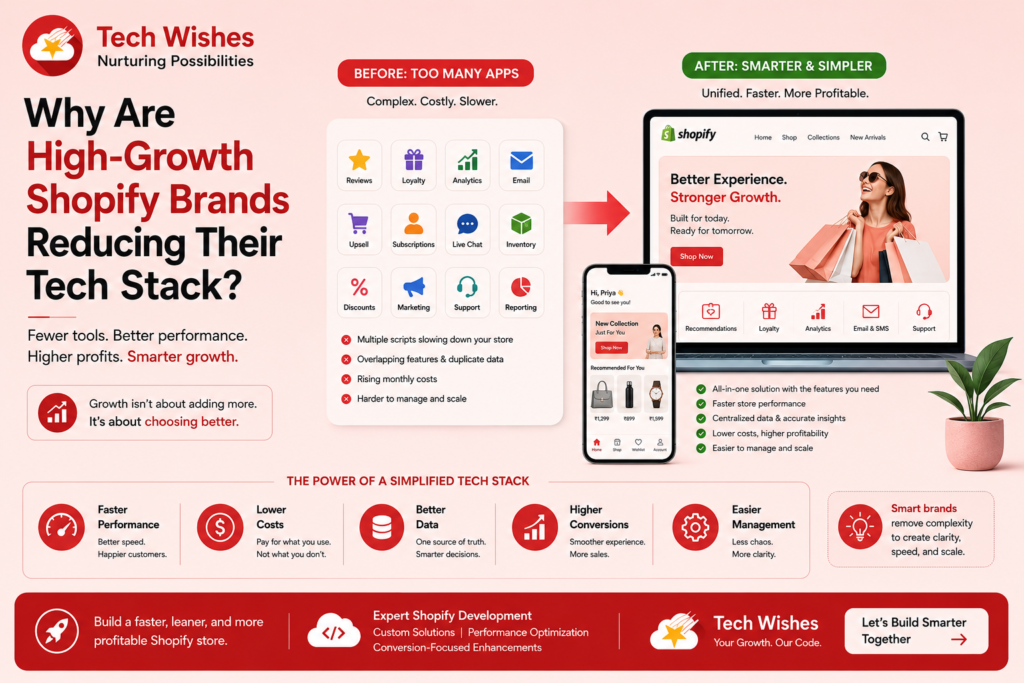
If you’ve noticed successful ecommerce brands using fewer tools than before, you’re not imagining it. Many high-growth Shopify brands are intentionally reducing their tech stack because more software doesn’t always mean better performance. Over the years, businesses have accumulated dozens of apps for reviews, subscriptions, upselling, analytics, loyalty, inventory, customer support, and marketing. The result? Slower websites, overlapping functionalities, rising subscription costs, and operational complexity. Instead of adding another app for every new challenge, today’s fastest-growing brands are simplifying their ecosystem, choosing integrated solutions, and investing in technology that genuinely supports long-term growth.
Growth often begins with adding tools. Scaling, however, is about knowing which ones to remove.
When More Apps Become a Business Problem
Shopify’s app ecosystem is one of its biggest strengths. With thousands of apps available, it’s easy to solve almost any problem in a few clicks. But as stores mature, those quick fixes start creating new challenges.
Many brands discover they’re paying for multiple apps that perform nearly identical functions. Others realise several apps inject scripts into the storefront, affecting loading speed and user experience. Teams spend more time managing software than serving customers.
A growing Shopify store doesn’t just need more features. It needs a smarter technology foundation.
Hidden Costs That Don’t Show Up on Your Shopify Invoice
Most merchants only look at monthly subscription costs, but the real expense of a bloated Shopify tech stack goes much deeper.
Consider what happens behind the scenes:
- Multiple apps competing for the same data
- Duplicate customer information across platforms
- Slower page speeds caused by unnecessary scripts
- Higher maintenance when apps stop supporting one another
- Increased training time for new employees
- More troubleshooting whenever updates break integrations
These hidden costs quietly reduce profitability even when sales continue growing.
Performance Is Becoming a Competitive Advantage
Customers have become less patient than ever. They expect product pages to load instantly, checkout flows to feel seamless, and every interaction to work without friction.
Every additional app introduces another potential point of failure.
That’s why many brands now evaluate software based on one simple question:
“Does this tool create more value than complexity?”
If the answer isn’t clear, it often gets removed.
For brands investing in Shopify development, improving performance isn’t only about coding better pages. It’s also about reducing unnecessary dependencies that slow the store down.
Consolidation Is Replacing App Collection
One of the biggest shifts happening in ecommerce is software consolidation.
Instead of using separate tools for upselling, product recommendations, sticky carts, analytics, and customer engagement, merchants are increasingly choosing platforms that combine multiple capabilities.
The benefits are immediate:
- Lower monthly software costs
- Cleaner integrations
- Better reporting
- Easier maintenance
- Faster storefront performance
- Improved customer experience
It’s not about using fewer features. It’s about accessing those features through fewer systems.
Better Data Starts with Fewer Silos
Every app collects valuable customer information. The problem arises when that data stays trapped inside individual platforms.
When marketing teams, customer support, inventory managers, and ecommerce managers all rely on different systems, decision-making becomes slower.
Reducing your ecommerce tech stack often leads to cleaner reporting because customer data becomes more centralised and easier to trust.
Instead of asking which dashboard has the correct numbers, teams can focus on improving the customer journey.
AI Is Changing How Brands Choose Technology
Artificial intelligence is also influencing technology decisions.
Rather than installing five different tools for recommendations, customer support, segmentation, and reporting, brands are increasingly looking for platforms that combine AI-powered capabilities within one ecosystem.
This reduces manual work while delivering better insights.
Modern Shopify apps are evolving beyond single-purpose tools. The best ones now solve multiple business problems without adding unnecessary technical overhead.
Every New App Should Earn Its Place
A useful habit many successful ecommerce teams have adopted is treating every new app like a new employee.
Before installing it, they ask:
- Does it solve a measurable business problem?
- Can an existing tool already do this?
- Will it improve revenue, efficiency, or customer experience?
- How will it affect website speed?
- Is it easy to remove if our needs change?
If those questions don’t have convincing answers, the installation usually doesn’t happen.
That mindset helps businesses avoid accumulating technology simply because it’s available.
Simplification Doesn’t Mean Limitation
Reducing your Shopify tech stack doesn’t mean sacrificing innovation.
In many cases, simplifying technology allows teams to move faster because there are fewer systems to maintain, fewer integrations to monitor, and fewer unexpected conflicts during updates.
The goal isn’t to become minimalist.
The goal is to become intentional.
Brands that scale successfully aren’t necessarily using the most software. They’re using the right software.
How Tech Wishes Helps Brands Build Smarter Shopify Stores
At Tech Wishes, we’ve worked with growing Shopify businesses that reached a point where adding another app was no longer the answer. Instead of recommending more tools, we help brands evaluate their existing ecosystem, identify overlapping functionality, improve Shopify performance, and build solutions that support long-term growth.
Whether it’s Shopify development, custom app development, performance optimisation, or conversion-focused enhancements, the objective remains the same: create a store that’s easier to manage, faster for customers, and built to scale without unnecessary complexity.
Technology should help your business grow, not become another challenge to manage.
FAQs
Is reducing a Shopify tech stack only useful for large brands?
Not at all. Even smaller stores benefit from reviewing their apps regularly. Removing redundant tools can improve website speed, reduce monthly expenses, and simplify operations long before scaling challenges appear.
How often should a Shopify store audit its apps?
A good practice is every three to six months. Regular audits help identify unused apps, overlapping features, outdated integrations, and opportunities to consolidate tools.
Can fewer Shopify apps actually improve conversions?
Yes. Faster page loads, fewer technical conflicts, and smoother customer journeys often contribute to higher conversion rates. A streamlined storefront generally creates a better shopping experience.
What are the signs that a Shopify tech stack has become too complex?
If your team struggles with multiple dashboards, rising software costs, slower site performance, duplicate data, or frequent integration issues, it’s probably time to simplify your technology stack.
Should businesses replace multiple apps with custom Shopify solutions?
It depends on the business. As brands grow, investing in custom Shopify development can often replace several third-party apps while providing better performance, greater flexibility, and a solution tailored to specific operational needs.